Temperature measurement is one of the basic principles in climate control systems. Sensors are installed everywhere to provide measurements to controllers. A common type is the thermistor. However, there are two variants: the NTC thermistor and the PTC thermistor. Both respond to temperature, but in opposite ways. How do both types work and when do you use which variant?
What is a thermistor?
A thermistor is a resistor element whose resistance value changes with temperature fluctuations. The name comes from “thermal resistor”. Unlike a standard resistor, which should remain as stable as possible, the change is the purpose in a thermistor. By measuring the resistance, a controller can derive the temperature.
Thermistors are widely used in HVAC systems because they are relatively inexpensive, respond quickly and can be made compact. They are found in room sensors, immersion sensors, surface sensors and duct probes.
How does an NTC thermistor work?
NTC stands for Negative Temperature Coefficient. In an NTC thermistor the resistance decreases as the temperature rises. That may sound counterintuitive, but it is a property of the semiconductor material from which the sensor is made.
For example: at 25°C an NTC thermistor might have a resistance of 10,000 ohms (10k). If it gets warmer, that value falls. At 50°C you might measure only 3,500 ohms. The relationship between temperature and resistance is not linear, which means the controller needs a conversion table to determine the correct temperature.
NTC thermistors are popular for accurate temperature measurement in the range of approximately -40°C to +150°C. They respond quickly to changes and are cost-effective.
How does a PTC thermistor work?
PTC stands for Positive Temperature Coefficient. Here the opposite happens: the resistance increases as the temperature increases. At low temperatures the resistance is low; at higher temperatures it rises.
A notable property of many PTC thermistors is that above a certain threshold temperature they exhibit a sharp jump in resistance. The resistance can then change within a few degrees from hundreds of ohms to thousands of ohms. This makes them suitable for protection applications.
PTC thermistors are less commonly used for precise temperature measurement. Their strength lies in detecting overheating or limiting current.
What is the difference between NTC and PTC thermistors?
Although both sensors respond to temperature, their applications differ significantly. Below are the main differences.
Resistance behavior with temperature rise
In an NTC thermistor the resistance decreases as it gets warmer. In a PTC thermistor the resistance increases. This fundamental difference determines their intended use.
Linearity and measurement accuracy
NTC thermistors have a predictable, albeit non-linear, behavior over a wide temperature range. With the proper conversion they are suitable for accurate measurements. PTC thermistors often show an abrupt resistance change at a specific temperature, which makes them less suitable for continuous measurement but useful for switching applications.
Temperature range and application area
NTC sensors perform well in the range relevant to climate control systems: from freezing temperatures to well above room temperature. PTC thermistors are more often used where overheating protection is required, for example in electric motors or heating elements.
When do you choose which type?
The choice depends on what you want to achieve with the measurement.
NTC thermistor for temperature measurement
If you need a controller to know the exact temperature, the NTC thermistor is usually the best choice. Room sensors, duct probes and immersion sensors in HVAC systems almost always use NTC elements. The 10k NTC at 25°C is a common standard.
PTC thermistor for protection and self-regulation
Do you want to protect a motor against overheating? Or are you looking for a self-regulating heater that automatically draws less power at higher temperatures? Then a PTC thermistor is suitable. The increasing resistance behavior causes the current flow to decrease automatically.
Combined applications in HVAC
In some installations both types are used. An NTC thermistor measures the temperature for control, while a PTC thermistor serves as protection in a pump motor. They complement each other.
The right thermistor for your application
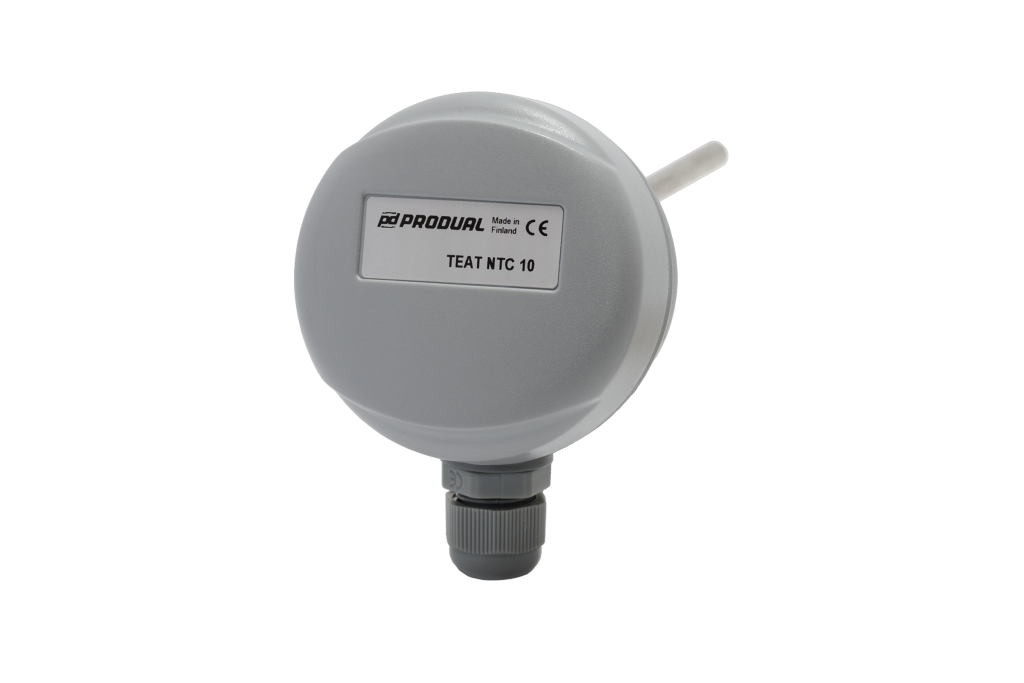
At Betec Controls we supply temperature sensors with both NTC and PTC elements. Our HVAC sensors from manufacturers such as Thermokon, Produal and Titec are equipped with NTC thermistors that connect directly to common controllers. Unsure which type of sensor suits your project? Our specialists will gladly advise you further. Contact us or reach us by phone: (055) 20 325 30.
Frequently asked questions about NTC and PTC thermistors
Can I replace an NTC thermistor with a PTC?
No, the operation is opposite. Your controller expects a specific resistance curve. The wrong type will lead to incorrect measurements or malfunctions.
Which thermistor is inside a standard room sensor?
Almost always an NTC thermistor, usually 10k ohm at 25°C. This is the common standard in building automation.
How long does a thermistor last?
Thermistors have no moving parts and last for years under normal use. Damage usually results from mechanical stress or moisture ingress.
Do you have questions about the right sensor for your installation? Contact us at (055) 20 325 30.