


A safety actuator automatically moves a damper to a predefined safe position in the event of a fault. This type of actuator is also known as a fail-safe actuator, safety actuator, or actuator with a safety function.
If the safety actuator works with a mechanical spring, the terms spring-return actuator, spring return actuator, and the English spring-return actuator are also used. These names refer specifically to an execution in which a preloaded spring moves the damper to the safe position.
However, not every safety actuator is a spring-return actuator. There are also electronic versions that store energy in a capacitor or battery. The general terms safety actuator and fail-safe actuator can therefore refer to both mechanical and electronic versions.
A safety actuator may be needed in the event of power failure, a fire alarm, or another emergency signal. The safety function helps protect people, systems, and buildings.
The safe position is not always Closed. An outdoor air damper often has to close in the event of a power failure. A smoke exhaust damper may need to Open instead. The function of the damper and the risk assessment therefore determine the correct end position.
When is a safety actuator needed?
|
|
|
|
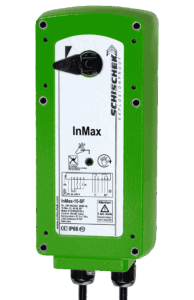
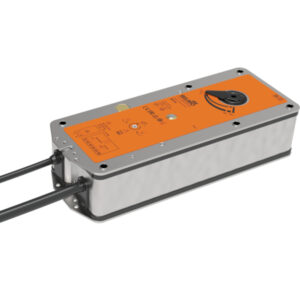
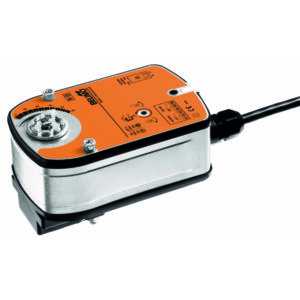
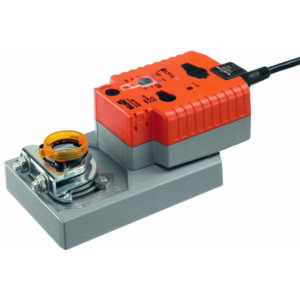
An actuator with a safety function is especially relevant when an incorrect damper position can have direct consequences. Think of fire and smoke control, frost damage, or an unsafe process. The operational reliability of the installation may also play a role.
Common applications are:
- Fire safety: a fire damper closes to limit the spread of fire and smoke through air ducts
- Smoke control: a smoke damper opens or closes according to the chosen smoke control concept
- Frost protection: an outdoor air damper closes to limit uncontrolled inflow of cold air
- System protection: a safe damper position helps prevent damage caused by freezing or overpressure, for example
- Process continuity: a safe end position can bring an industrial process to a controlled stop or limit product loss
- Project requirements: regulations or project specifications may require a certain safety function
For fire and smoke applications, specific requirements often apply. Therefore, do not only look at the actuator, but at the complete safety chain. In the range fire safety and smoke exhaust you will find actuators for these applications.
How does a spring-return actuator work?
A mechanical spring-return actuator is the most commonly used version of a safety actuator. During normal operation, the electric motor moves the damper to the operating position. At the same time, the actuator preloads a spring.
If the power fails or an emergency signal occurs, the spring takes over. The stored mechanical energy moves the damper to the set safety position. This principle is also called spring return or spring return.
The safety position can have two forms:
- Normally Closed (NC): in the event of a fault, the damper moves to the Closed position.
- Normally Open (NO): in the event of a fault, the damper moves to the Open position.
The NO or NC designation only indicates the safe end position. Also check the direction of rotation, mounting position, and mechanical connection.
Electronic safety function as an alternative
In addition to mechanical spring-return actuators, there are safety actuators with an electronic safety function. A battery or capacitor temporarily stores energy for this purpose. In the event of a power failure, the actuator uses this energy to move once to the safe position.
Both solutions have the same purpose, but work differently technically. Therefore, pay attention to the required running time, available power supply, and maintenance strategy. Also check how the safety position is set and tested.
Practical example: frost protection of an air handling unit
An Open outdoor air damper can allow cold air into an air handling unit that has stopped in winter weather. As a result, a heat exchanger or heating coil can freeze.
A spring-return actuator, such as a suitable version from the LF series, can close the damper in the event of a power failure. A frost protection device, for example a JTF-21, can also detect a drop in temperature. The control system can then intervene before damage occurs.
Together, these components form a functional safeguard. The safety actuator therefore does not replace the frost monitoring. Conversely, a Sensor cannot move the damper to the safe position on its own without a suitable actuator.
Safety actuators for fire and smoke detection
A smoke alarm can be part of the management of fire, smoke, or ventilation dampers. The UG8-E-230 is, for example, an optical duct smoke detector. The EVC-PY-DA is the corresponding optical detector type in this version.
Specialized safety actuators are available for damper control. The BF24-SR-TN is an example for a fire damper application. The BE24 can be used with smoke control dampers. Always check the combination of damper and actuator, the associated documentation, and the applicable requirements for each project.
How do you choose the right safety actuator?
Start with the function that must be maintained in the event of a fault. Then determine whether the damper must Open or close. Record this choice in the risk assessment or control description.
Then check at least:
- the required torque
- the supply voltage
- the desired running time and spring return time
- Open/close, three-point, or modulating control
- any position or end-position feedback
- the shaft size and mechanical mounting
- the protection class and environmental conditions
- project-specific standards and regulations
Also assess the complete chain. Selecting the correct safety actuator alone is not enough. Sensor, controller, wiring, power supply, actuator, and damper must together perform the intended safety function.
How do you determine the torque of an air damper actuator?
As an initial indication, a rule of thumb of 5 Nm per m² damper area is sometimes used. However, this value is not definitive sizing. The required torque depends on the design and mechanical load of the damper.
Therefore, always follow the specifications of the damper manufacturer. Also take into account seals, bearings, air pressure, contamination, and the mechanical transmission. Only then choose an actuator with sufficient torque and a suitable safety function.
Advice on a safety actuator
The right safety actuator follows from the application, not only from the damper area. Betec Controls will gladly help you align safety position, torque, power supply, and control. This way, you select an actuator that fits both the damper and the control strategy.
Frequently asked questions
What is a safety actuator?
A safety actuator automatically moves a damper to a predefined safe position in the event of a fault. This type of actuator is also called a fail-safe actuator, safety actuator, or actuator with a safety function.
Is every safety actuator a spring-return actuator?
No. A spring-return actuator uses a mechanical spring to reach the safe position. A safety actuator can also have an electronic safety function with a capacitor or battery.
Must a damper with a safety actuator always close?
No. The safe position depends on the application. An outdoor air damper often closes in the event of a fault, while a smoke exhaust damper may need to Open instead.
What is the difference between a normal actuator and a spring-return actuator?
A normal actuator usually remains in its last position in the event of a power failure. A spring-return actuator uses stored mechanical energy to move the damper to the safe position.
Can a safety actuator work electronically?
Yes. An electronic safety function uses stored electrical energy from, for example, a capacitor or battery. This allows the actuator to move once to the safe position in the event of a power failure.
How many Nm does an air damper actuator need?
A rule of thumb of 5 Nm per m² gives only an initial indication. Base the final choice on the damper manufacturer’s data and the actual mechanical load.
Do you have questions about these products or this article? Then please contact us. You can do so by phone at +31 (0)55 20 325 30 or by email info@beteccontrols.nl or, also nice, via chat!


